
In 2025, China’s production and sales of new energy vehicles both exceeded 16 million units, with the penetration rate of new cars approaching 48%. As the vehicle electronic and electrical architecture evolves from distributed to domain-centralized and central computing architectures, on-board wire harnesses, regarded as the "neural network" of vehicles, are becoming increasingly complex. Cable tie bundling, a process long reliant on manual labor, has become a prominent bottleneck restricting the quality and output of wire harness production lines.
Wire harness assembly is among the least automated components in vehicle manufacturing. At present, leading factories have achieved high-speed automated production at a cycle time of 4 seconds per wire for cutting, crimping and testing. Nevertheless, many domestic wire harness manufacturers still rely on manual work for cable tie bundling. Manual bundling comes with inherent drawbacks: the tightness depends entirely on workers’ feel, and the tension applied by operators on different shifts can differ by up to double. Over-tight bundling may damage wire insulation, while insufficient tension causes harness displacement under vehicle vibration, triggering interior abnormal noises and after-sales complaints. The leftover tail length of cable ties is controlled by experience. Inconsistent tail lengths hurt assembly appearance, and excessively long tails may interfere with adjacent parts within the narrow sheet metal cavity of the vehicle body, bringing potential assembly risks. Especially at irregular positions such as junctions of thick main harnesses and thin branches, bracket fixing points and sensor outlets, it is hard to standardize the angle and routing of cable ties. Conventional equipment struggles to handle these scenarios, leaving manual operation as the only option.
Industry statistics show the defect rate of manual bundling remains at 7%–9%. For factories producing hundreds of thousands of harness sets annually, high defect rates translate into continuous costs for rework and inspection. Coupled with difficulties recruiting and retaining skilled bundling workers, wire harness manufacturers have an urgent need to cut costs and improve quality.
Targeting these industry pain points, Suzhou Sanao Electronic Equipment Co., Ltd. has focused on the automation of cable tie bundling. As one of China’s early original manufacturers in this sector, the company has iterated desktop, handheld and semi-automatic cable tie equipment. After completing the R&D of the new-generation tie tensioning and tail cutting machine in 2023, Sanao did not rush into market rollout. Instead, the machines were deployed to frontline harness production lines for continuous commissioning and iteration based on customers’ real working conditions. Following more than two years of on-site verification, the product was officially launched in 2025.
The SA-SC400 cable tie tensioning & tail cutting machine is custom-built for harness production lines. It supports standard cable ties as well as special automotive ties including tree-style, aviation-head and arrow-head types, compatible with wire harnesses of various diameters. It enables precise positioning at complex points such as branch junctions. With bundling tension and tail length parameters preset in the equipment, every bundling cycle delivers consistent performance after commissioning, eliminating variations caused by human feel. Thanks to standardized operation, the machine cuts the bundling defect rate from 7%–9% to below 1%.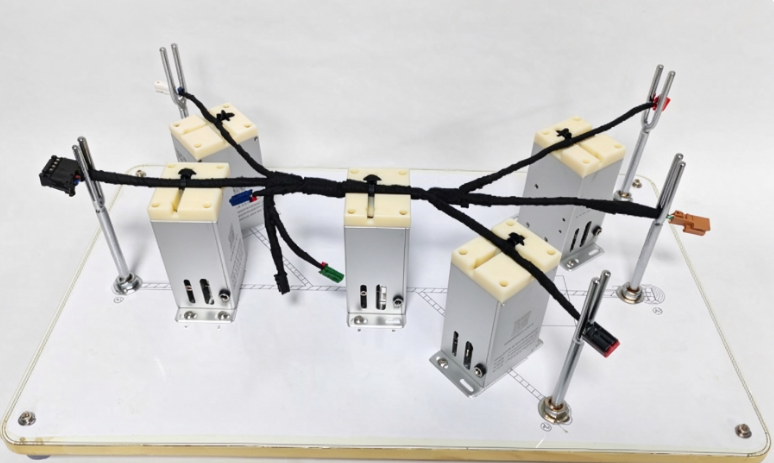
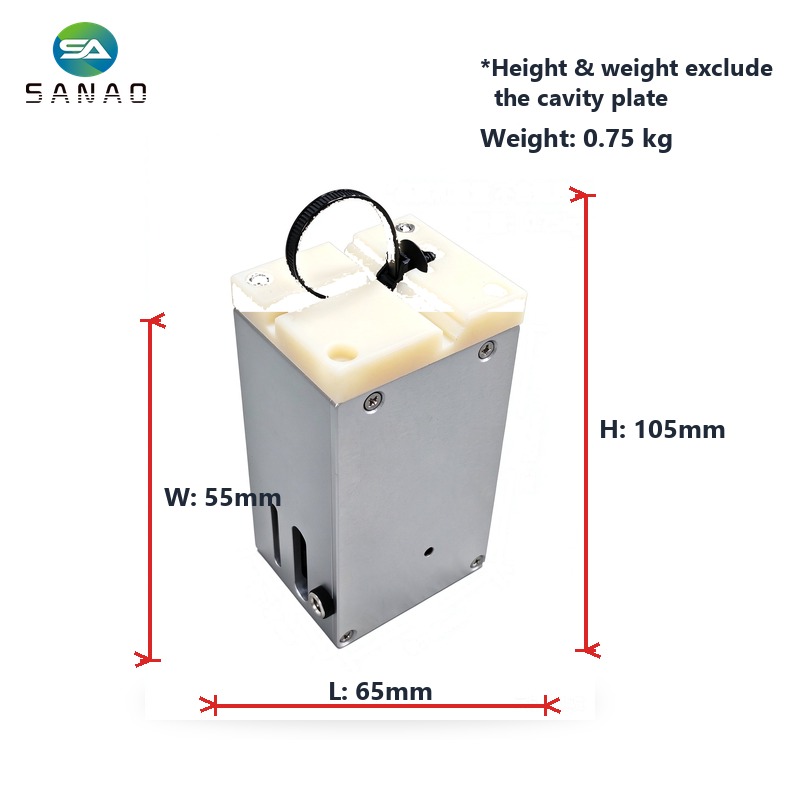
This semi-automatic machine works as follows: after operators place the harness and cable tie, the machine automatically finishes tensioning, tail cutting and waste ejection. It supports three trigger modes: foot pedal, button and infrared sensor, with a cycle time of around 2 seconds. Tension can be adjusted via a calibrated knob, and tail length is conveniently modified by replacing gaskets. Weighing merely 0.75 kg and compact in size, the machine requires no air source and runs on AC220V power supply. It fits retrofitting of existing harness production lines and can also be integrated into full-automatic new energy harness assembly lines as a standardized workstation.
 Industry insiders note that new energy vehicles are moving toward higher integration and reliability, and process standards for wire harnesses keep upgrading. Automation in harness manufacturing should not be limited to upstream processes like crimping and cutting. Automated upgrading for seemingly minor yet reliability-critical processes such as cable tie bundling helps harness manufacturers reduce human errors and ease labor pressure, completing a key link in quality upgrading of the new energy vehicle supply chain.
Post time: Nov-17-2026