
In 2025, China’s production and sales of new energy vehicles both exceeded 16 million units, with the penetration rate of new cars approaching 48%. As vehicle electronic and electrical architectures rapidly upgrade toward domain-centralized and central computing systems, on-board wire harnesses, the vehicle’s “neural network”, have grown increasingly complex with a sharp rise in junctions between main cables and multiple branches. Cable tie bundling, a process long performed manually, has become a bottleneck for harness factories aiming to boost yield and production capacity.
Pain Points of Manual Cable Tie Bundling in Harness Factories
Wire harness assemblies are among the least automated components in vehicle manufacturing. Cutting, crimping and electrical testing have long achieved high-speed automation. However, many harness manufacturers still rely on manual labor for cable tie bundling. Manual bundling presents obvious pain points: tension depends entirely on workers’ feel, and tension variation between different shifts can be as high as 100%. Over-tight bundling risks damaging wire insulation, while insufficient tension allows harness movement under vehicle vibration, causing interior abnormal noise and after-sales complaints. Cable tie tail length is trimmed by experience, resulting in inconsistent leftover tails. Excessively long tails may interfere with surrounding components inside narrow vehicle sheet metal cavities and create assembly hazards. Especially at branch junctions, bracket mounting points and sensor outlets, the fixing angle of cable ties is hard to standardize. Conventional single machines struggle to handle multiple branch nodes simultaneously, which has long been a pain point for automation upgrades.
Industry statistics show the defect rate of manual bundling stays between 7%–9%. For factories producing hundreds of thousands of harness sets annually, high defect rates lead to substantial rework and inspection costs. Coupled with difficulties recruiting and retaining skilled bundling workers, harness manufacturers have an urgent demand for automated bundling solutions capable of handling multiple branch points in one setup.
Multi-station Modular Cable Tie Bundling Solution
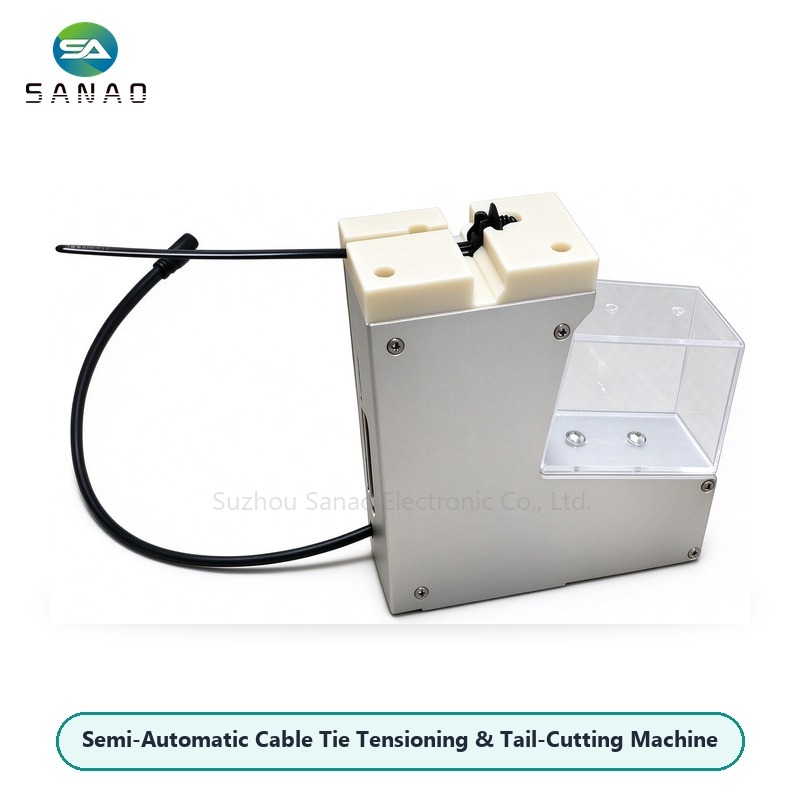
To address bundling difficulties at multi-branch harness nodes, a modular multi-station cable tie tensioning and tail-cutting module has been launched. This solution integrates multiple cable tie tensioning & tail-cutting units onto one positioning fixture plate, enabling simultaneous bundling at several branch points of a complete harness in a single operation, ideal for the complex branching structures of new energy vehicle wire harnesses. The full module supports standard cable ties as well as automotive special ties such as tree-style, aviation-head and arrow-head types, compatible with harnesses of various wire diameters, and delivers precise positioning at complicated multi-branch junctions.
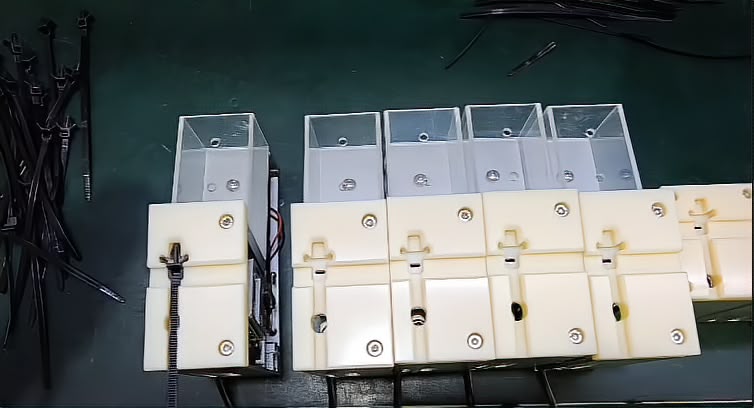
Bundling tension and residual tail length are preset as equipment parameters. Once commissioned, every bundling cycle delivers consistent performance and eliminates human-induced tension fluctuation. The system reduces bundling defect rate from 7%–9% to below 1%. Each bundling unit works in semi-automatic mode. After the operator places the harness and cable tie, the machine automatically completes tensioning, tail cutting and waste ejection. Three trigger modes are available: foot pedal, button and infrared sensor, with a cycle time of approximately 2 seconds per station.
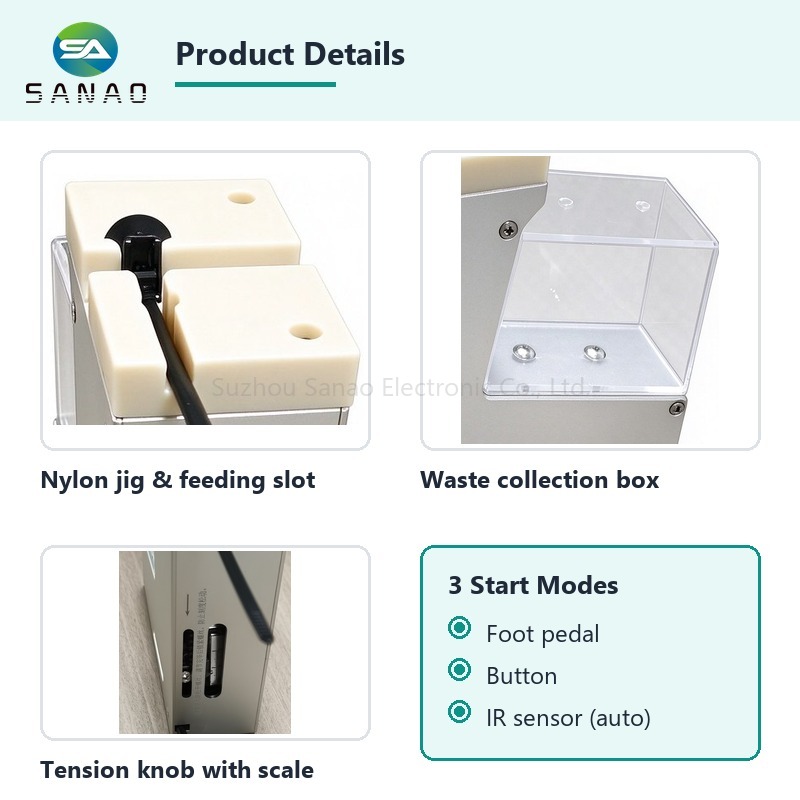
Bundling tension can be adjusted via a calibrated knob, and tie tail length can be quickly modified by replacing gaskets. Compact and lightweight, each unit requires no air source and runs on AC220V power supply. The whole fixture can be flexibly integrated into existing harness assembly lines, or used as a standalone workbench for prototype trials and small-batch production.
From Manual Know-how to Standardized Machine Parameters
Multiple patents protect the core hardware design. According to the R&D lead, patents cover the mechanical structure, while process logic and stability tuning refined over more than a decade working in harness workshops form the core competitiveness of this solution. Competition in the new energy vehicle industry has shifted from range metrics to stable supply chain processes and manufacturing cost control. For harness enterprises, cable tie bundling, though seemingly trivial, directly impacts harness yield, after-sales complaints and overall line takt time. This multi-station modular solution converts manual know-how into standardized machine parameters to realize automated synchronous bundling at multi-branch harness nodes. It fills the automation gap in new energy wire harness manufacturing and helps upstream supply chains improve quality and cut costs.
Post time: Nov-19-2026