
https://www.sanaoequipment.com/wire-cutting-crimping-machine/
In the wire processing industry, choosing the right terminal crimping machine is critical to production efficiency and product quality. When expanding your business or upgrading equipment, you often face a classic question: Should I choose a semi-automatic or fully automatic terminal crimping machine?
Both types have their own strengths, but they suit different production scales, budget ranges, and wire type requirements. In this detailed guide, we will analyze their differences in working principle, efficiency, cost, and application scenarios to help you make the most cost-effective decision.
1. Core Differences: How Do They Work?
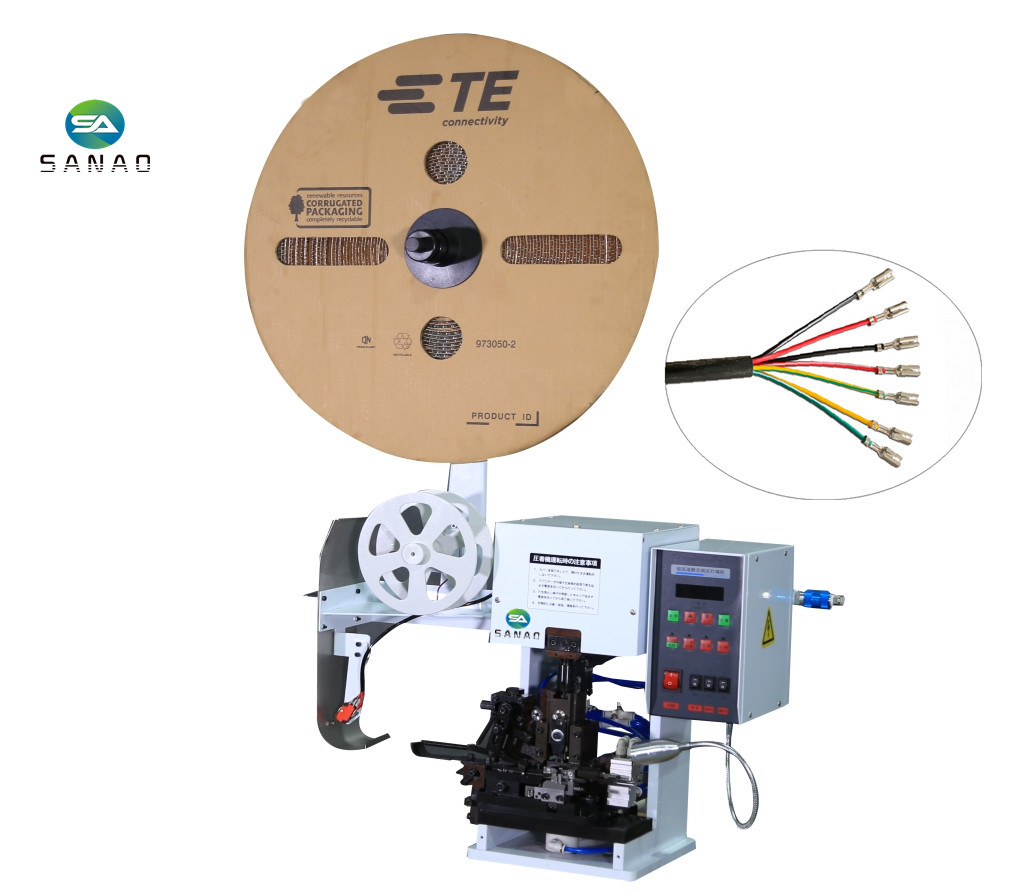
A. Semi-Automatic Terminal Crimping Machine
A semi-automatic machine requires manual intervention in most steps.
- Operation Flow: Usually, an operator needs to place the wire into the terminal manually, then start the machine for crimping. After crimping, the operator removes the finished product.
- Core Feature: It relies on human hands to feed and discharge materials. The machine only provides the crimping force.
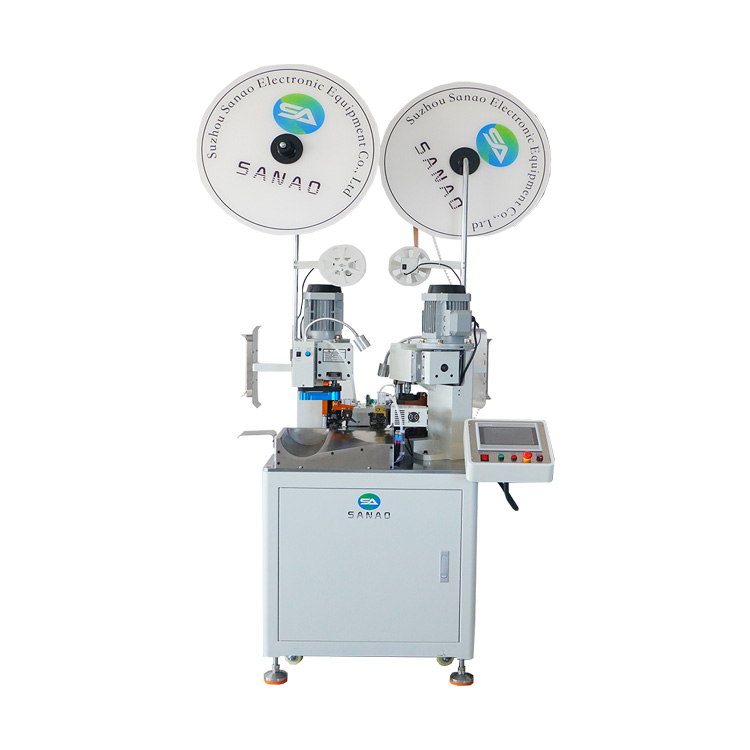
B. Automatic Terminal Crimping Machine
An automatic machine integrates feeding, stripping, crimping, and cutting into one continuous process.
- Operation Flow: Operators only need to put the wire reel onto the machine. The system automatically strips the insulation, feeds the wire, crimps the terminal, and cuts it off. Some high-end models even support sorting and stacking.
- Core Feature: It uses servo motors and precision sensors to achieve full automation, minimizing human intervention.
2. Key Comparison: Which is Better for You?
We have summarized a comprehensive comparison table to help you visualize the differences:
| Comparison Items | Semi-Automatic Crimping Machine | Automatic Crimping Machine |
| Initial Cost | Low (Affordable for small businesses) | High (Heavy investment for large-scale production) |
| Production Efficiency | Low (Depends on operator speed; ~500-1500 pcs/h) | High (Unlimited by human speed; ~3000-10000 pcs/h) |
| Labor Cost | High (Requires 1-2 dedicated operators) | Low (1 worker can monitor 2-3 machines) |
| Crimping Precision | General (Affected by operator proficiency) | Superior (High precision via servo control) |
| Operator Training | Short (Easy to learn, 1 day to get started) | Long (Requires technical knowledge to handle programming) |
| Suitable Wire Type | Suitable for single-core wires or large batches | Suitable for multi-core wires, thin wires, and complex harnesses |
3. When to Choose a Semi-Automatic Machine?
A semi-automatic machine is the best choice if you meet one or more of the following conditions:
- You are a startup or a small business:
If your monthly order volume is not large (e.g., less than 50,000 terminals) and you have a limited budget, a semi-automatic machine offers a high return on investment.
- Your production requires high flexibility:
If you process a wide variety of wire types and sizes, and frequent model changes are required, semi-automatic machines are more agile and less time-consuming to adjust.
- Simple wiring harness processing:
If your products are simple wire ends with no complex multi-core structure, semi-automatic machines can fully meet the quality standards.
4. When to Invest in an Automatic Machine?
Choose an automatic machine if your goal is to expand production scale or improve product competitiveness:
- Large-scale production needs:
If you have stable, large orders (e.g., 100,000+ terminals per month) and need to reduce labor costs, automatic machines can significantly lower your long-term operational costs.
- High-precision requirements:
For products like automotive wiring harnesses or precision electronic components, even a tiny crimping defect can cause failures. Automatic machines ensure consistency and zero human error.
- Long-term business development:
Upgrading to automatic equipment is a sign of industrial upgrading. It can improve your production capacity to take on bigger projects and attract high-end customers.
5. Pro Tips for Selection
- Check Your Wire Gauge:
If you are working with ultra-fine wires (such as AWG 30-38), an automatic machine with a precision servo system is a must, as semi-automatic machines may struggle with such small materials.
- Calculate the Break-even Point:
Use the formula:
(Cost of Automatic Machine - Cost of Semi-Automatic Machine) / (Monthly Labor Saving) = Break-even Months.If the break-even point is within 1-2 years, the automatic machine is more profitable in the long run.
- After-Sales Service Matters:
Automatic machines are complex. Ensure your supplier provides reliable technical support and spare parts supply.
Conclusion
There is no absolute “better”—only “more suitable”.
- Semi-automatic is the right start for small businesses, focusing on cost-effectiveness.
- Automatic is the future of high-efficiency manufacturing, focusing on scalability and quality.
At [Your Brand], we provide a full range of terminal crimping solutions. Whether you need a basic semi-automatic model or a high-speed fully automatic production line, we can customize the perfect solution for your business needs.
Contact us today for a free consultation and quotation!
Post time: Mar-18-2026